Una supports over 100 integrations across finance and GTM systems, with bi-directional sync and support for real-time, batch, or manual push. With all your data in one spot, Una becomes the single source of truth for Finance, Sales, Customer Success, and Operations.
%202.webp)
No—modern FP&A platforms like Una are designed to support adaptive planning, meaning changes to business structures (e.g., departments, products, regions) are automatically handled rather than rebuilding integrations. Una’s platform enables organizations to adapt plans quickly and continuously as the business evolves, which could also include new dimensions (e.g., Currency, Entity, Market).
Una integrates financial and operational data and applies AI-driven analytics and embedded business intelligence to improve forecasting and planning accuracy. This implies the platform can ingest diverse datasets and normalize them during planning and reporting workflows, helping finance teams work with imperfect operational data rather than requiring perfectly clean inputs.
Una promotes revenue-connected and operational planning, meaning planning is not restricted to aggregated GL accounts. Finance teams can incorporate operational drivers (e.g., revenue, KPIs, departmental metrics) to create more granular and driver-based forecasts tied to business activity.
Una aims to serve as a connected performance management platform, consolidating financial and operational inputs into a shared planning environment. While core systems (ERP, CRM, etc.) remain the system of record, Una acts as the unified planning layer that reduces manual reconciliation by aligning data, forecasts, and execution tracking in one platform.
Una emphasizes fast deployment and usability for finance teams, so integrations and ongoing configuration are designed to minimize heavy IT involvement compared with traditional enterprise implementations. This reflects the platform’s goal of delivering value quickly without the “heavy lift” typical of legacy FP&A deployments.
Una’s platform is designed to incorporate operational signals in real-time, allowing teams to adjust plans as business conditions change. While integrations may still depend on source system capabilities, the planning environment itself is built to react to real-time data.
Una includes embedded business intelligence and analytics, enabling users to analyze and explore financial performance beyond summarized planning numbers. This includes drill-downs into underlying drivers or detailed datasets that inform forecasts and budgets.
Una is AI-native, meaning AI is built into the core platform and planning engine rather than added later as a separate feature. Unlike legacy FP&A tools where AI sits on top of manual models, Una’s AI works directly within the data, forecasts, and workflows to continuously analyze drivers, generate insights, and support adaptive planning.
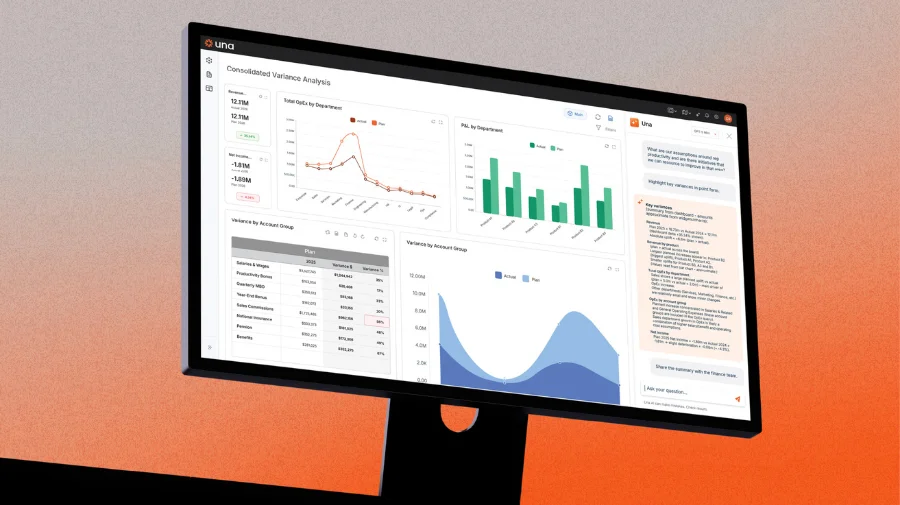
Ready to take control of your budgeting, planning, forecasting and reporting? Schedule a demo and see how Una’s financial planning & analysis software can work for you.
Schedule Demo