A recent newsletter from the Chief Marketing Officer Alliance declares that “CFOs don’t trust your forecast,” and prescribes a handful of measures to remedy this.
The Alliance refers to a study by Miller Heiman Group finding fewer than 20% of sales organizations achieve forecasting accuracy of 75% or better, and Gartner reporting that less than half are highly confident in their forecasts.
Revenue orchestration software vendor Clari found an astounding 93% of sales leaders couldn’t forecast revenue to within 5% - even with just two weeks left in the quarter!
And if sales leaders can't reliably forecast revenue, one can hardly expect marketers to reliably forecast the revenue their programs will generate. They're two sides of the same coin (pardon the pun).
In short, this CFO-CMO-CRO distrust is very real.
Why? And more importantly, how can we fix it?
As revenue leaders, how can we build not just CFO trust in, but appreciation and understanding of our projections? Heck, I want them to love our forecasts!
The Alliance points to the problem of large marketing budgets based on gut feel, with no concrete ROI or predictable revenue results. And sure, we’ve all seen those before.
If you were around during the dot-com era, you’ll recall that was the standard. Where “eyeballs” were the new currency and revenue was an obligatory bridge you’d cross when you got to it.
But only after you “crossed the chasm” and used “first mover advantage” to capture a critical mass of market share.
Those were strange times, but more research from Gartner is just as telling about where we are today - that 67% of companies don’t even have a formalized approach to forecasting.
So how do we reverse these numbers? How do we get CFOs to trust and love our forecasts? Three things:
THE LANGUAGE: CONNECTING REVENUE DATA & METRICS
The CMO Alliance suggests CMOs and CFOs start speaking the same language, and that means the right data and metrics. Not, as they say, on gut feel.
Salesforce research backs this up, finding the top performing 25% of sales organizations use a data driven approach to forecasting.
For that top quartile, the revenue pipeline is a vast resource of forecasting intel. Intel that’s used daily in sales and marketing, but rarely in the budgeting and planning process.
I’m not talking about the eyeballs of the dot-com era, or the likes and shares of today.
Conversion rates, the cost of acquiring a new customer, revenue, churn. These are the factors that determine your future revenue. They may be dynamic, but they’re easy to measure and factor into your forecasting - if you have a revenue connected FP&A solution.
And your CFO shouldn’t just know what they mean, but know what they are and how they’re changing.
THE RELATIONSHIP: SPENDING QUALITY TIME IN REVENUE
Jumping off financial statements and systems for a minute, consider that trust only comes when it’s based on a strong relationship.
To this end, how much time does your CFO spend in sales and marketing? Or customer success?
Considering the importance of revenue to your overall forecasting, is it enough? Is it much at all?
You can change that.
Invite your CFO to be part of forecasting and other important meetings. Not so they have to hear what the latest click through or social engagement numbers (I’ve heard referred to as vanity metrics), but so they get a firsthand appreciation and understanding of things like:
Spending time with your team will also make sure they hear the revenue story they need to tell. And in the process, lending their expertise to make your revenue story even better..
THE TECHNOLOGY: AI IS THERE FOR THE TAKING…OR LOSING
The CMO Alliance newsletter also includes an article about 99% of CMO budgets including greater investments in AI.
Even in finance, according to Bain Capital, nearly 80% of notoriously late tech-adopting CFOs are doing the same.
We all know AI’s impact is going to be felt across every department in our companies. Andreesen Horowitz even highlighted how AI is nudging technology companies to change pricing from a subscription to a consumption model in their most recent LinkedIn newsletter.
But whether you’re using it for content creation, competitive research or indeed revenue forecasting, you’ve got to be using it to automate the mundane, manual work that plagues both finance and revenue departments.
So you, your CFO, and your teams can spend your time doing only what you can. Spurring innovation, building relationships and scrutinizing the analysis that AI performs. Making sure you’re using your human intelligence to drive the growth you need.
Everything I’ve talked about above is what the latest FP&A software was built to do. With revenue-connected planning, AI-driven forecasting, embedded BI and more.
So you can focus on strategy and growth. So you and finance are speaking the same language. And so your CFO trusts your forecasts.
Maybe even loves them:)
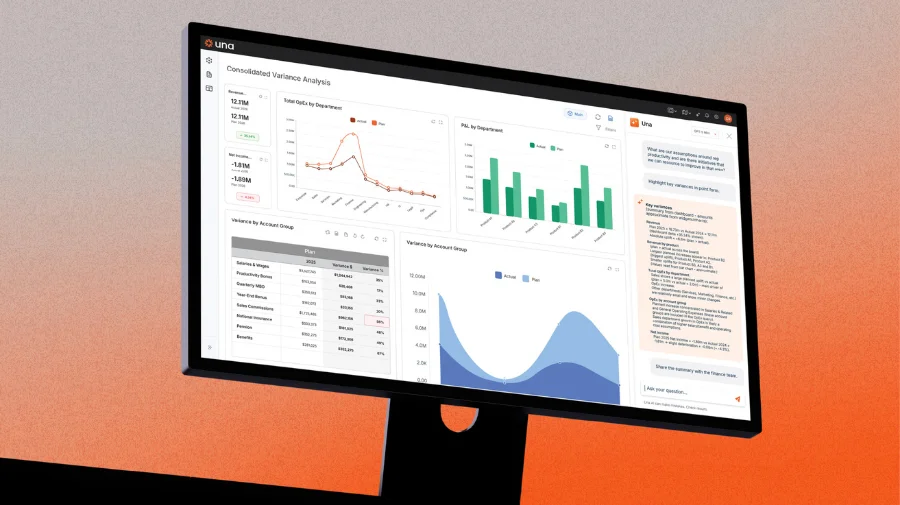
Ready to take control of your budgeting, planning, forecasting and reporting? Schedule a demo and see how Una’s financial planning & analysis software can work for you.
Schedule Demo